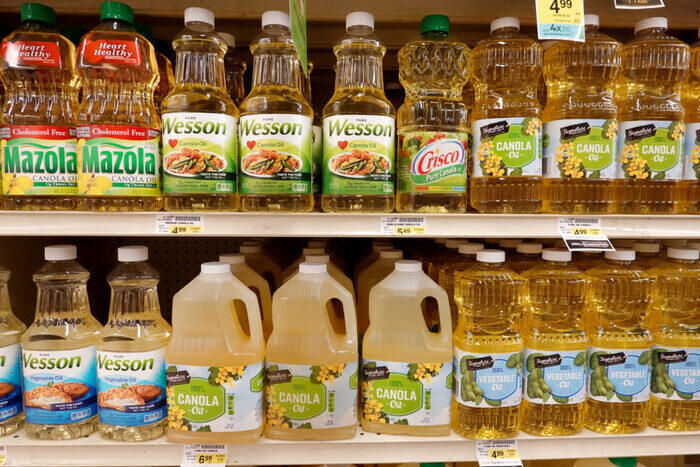
Yahoo Health is running a piece this week (syndicated from EatingWell) under the headline “Scientists Just Debunked Every Myth About Seed Oils — Here's What They Found.” The article is built around a single recent paper: a review in Critical Reviews in Food Science and Nutrition that concludes seed oils like canola and soybean don't cause inflammation and are actually beneficial for heart health.
The article calls it “reassuring across the board.” It quotes the lead author. It tells you to feel “confident cooking with seed oils.”
What it doesn't tell you — and what the LSAT would crucify a student for missing — is who paid for the study.
The press release from the Soy Nutrition Institute Global, announcing the very paper Yahoo is citing, includes one line buried near the bottom:
“This manuscript was partially funded by Soy Nutrition Institute Global, with support from the United Soybean Board.”
That's the entire ballgame. Let me walk through why, and then through the other logical flaws stacked on top of it.
1. The Big One: Conflict of Interest As Suppressed Evidence
Here's a logic puzzle. Suppose I told you:
“A new review of the scientific evidence finds that cigarettes do not cause cancer. The lead author says claims linking smoking to disease are 'driven by social media narratives.'”
Before you decide whether to believe it, what is the first question you would ask?
Right. Who funded it?
Now run the same exercise with the seed oil paper. The review concludes that soybean oil and canola oil are safe and heart-healthy. The funder is the Soy Nutrition Institute Global, which is itself a checkoff-funded body backed by the United Soybean Board — i.e., the trade association whose entire reason for existing is to sell more soybean oil.
If you're an LSATMax student, this should feel familiar. It's the same dynamic we documented two years ago in Beware of LSAT Wolves in Sheep's Clothing: the r/LSAT subreddit relentlessly promotes 7Sage as “the best” LSAT prep course, while the subreddit's moderator, Graeme Blake, had been professionally affiliated with 7Sage — a fact he conspicuously scrubbed from his public bio shortly after we published. (The Internet Archive remembers what bios forget.) Same flaw, different industry: a venue presented as a neutral information source recommending a specific product, while quietly omitting the financial relationship between the recommender and the recommended.
This isn't speculation about the seed oils paper either. It's not even something you have to dig for. The United Soybean Board says it openly in its own press release from April 2025:
“The Soy Checkoff invests to protect U.S. soybean farmers' stake in the edible oils market and uphold the reputation of the healthfulness of soybean oil… Together with our partners, we're working to reclaim the narrative around seed oils.”
And then, the part that should stop you cold:
“In amplifying seed oil benefits and findings from these checkoff-funded manuscripts, USB secured top tier media coverage in NY Post, CBS News, EatingWell, Men's Health and Good Housekeeping.”
The Yahoo Health article is reprinted from EatingWell. EatingWell is explicitly named in the trade association's own brag sheet as a placement outlet for industry-funded seed-oil content.
This is the logical fallacy called suppressed evidence — also known on the LSAT as a critical omission. An argument that leaves out the single most relevant fact a reasonable person would weigh isn't an argument; it's a sales pitch. And the omission here isn't subtle. It's not “we forgot to mention.” It's a documented multi-million-dollar trade-group strategy to place pro-seed-oil content in the exact outlet where this article appeared, citing the exact paper it's built around.
Now — does industry funding automatically mean the conclusion is wrong? No. Industry-funded research can be correct. Stanford nutrition researcher Christopher Gardner made this exact point recently: many of his industry-funded trials returned null findings against the funder's interest, and he published them anyway. Good faith exists.
But Gardner's own rule is the right one: “You should ALWAYS be extra cautious when considering research that was funded by a group with a vested interest in the outcome of the findings.” That's the standard. Not “ignore it.” Not “trust it blindly.” Caution. And caution requires disclosure, which is exactly what the Yahoo article omits.
If you want to know how seriously to take a study, follow the money. If you can't follow the money because the article hides it from you, that itself is the story.
2. The “Wellness Content” Smear — Ad Hominem Against Critics
Notice how the article frames the people who question seed oils:
“If you've been scrolling wellness content lately, you've probably seen someone telling you to throw out your canola oil.”
And the lead author, in the press release version:
“Much of the concern around seed oils is driven by social media narratives rather than robust scientific evidence.”
This is a classic ad hominem — attacking the source rather than the substance. “Wellness content” and “social media narratives” are framing devices that tell the reader the people raising the question are unserious before any of their actual arguments are addressed.
Some of the most vocal seed oil critics are, in fact, social media personalities with no credentials. Fine. But others are credentialed lipid biochemists, cardiologists, and metabolic researchers raising specific mechanistic questions about industrial seed oil processing, oxidation byproducts, and 4-hydroxynonenal formation. The article does not engage with those arguments. It folds them all into “wellness content” and walks away.
On the LSAT, this is exactly the trick a wrong answer choice pulls: dismiss the source instead of addressing the argument. It scores zero.
3. “Seed Oils” Is Not One Thing — Equivocation
The article lists the category like this:
“Seed oils (including canola, corn, cottonseed, grapeseed, peanut, rice bran, safflower, sesame, soybean and sunflower)…”
Then proceeds to conclude things about “seed oils” as a category.
But these oils are not interchangeable. Their linoleic acid content ranges from roughly 10% (high-oleic safflower) to roughly 75% (safflower, regular). Their oxidative stability varies by an order of magnitude. Some are mechanically pressed, some are hexane-extracted and chemically refined through multiple high-heat deodorization steps. Sesame oil is typically cold-pressed and used in tiny culinary amounts; soybean oil is the bulk industrial frying oil of the American food supply.
Lumping them together and concluding “seed oils are fine” is equivocation — using a single term to cover a category whose members behave so differently that the conclusion can't legitimately apply across all of them. It's the same flaw as concluding “alcohol is healthy” from a red-wine study.
Worth noting: it's also not a coincidence which seed oils the funders care about. The Soy Checkoff doesn't fund research on grapeseed oil. It funds research on soybean oil and packages the conclusion as “seed oils.”
4. The Headline — Hasty Generalization From a Narrative Review
The Yahoo headline says scientists debunked every myth.
The article's own description of the underlying paper:
“This was a scoping narrative review, meaning the researchers gathered and interpreted a broad range of existing human research rather than conducting a new experiment.”
A scoping narrative review is the least dispositive form of literature synthesis. It's not a systematic review with predefined inclusion criteria. It's not a meta-analysis with statistical pooling. It's a narrative — researchers selecting which studies to discuss and how to characterize them. By design, narrative reviews are interpretive. They reflect the authors' framing.
“Debunked every myth” is not a thing a scoping narrative review is capable of doing, in the same way that a book report is not capable of disproving the book. The headline is a hasty generalization built on top of the weakest possible evidentiary base.
5. “Compared to Saturated Fat” — Cherry-Picked Comparison
Almost every “benefit” finding in the article has the same hidden qualifier:
“…findings consistently supported replacing saturated fats with polyunsaturated fats (the type found in seed oils) to reduce cardiovascular risk.”
“Replacing saturated fats with linoleic-acid-rich oils may help reduce liver fat…”
“Seed oils can be part of a healthy diet, with the highest quality research suggesting they may reduce heart disease risk compared to saturated fat sources like butter or beef tallow.”
Read those carefully. Every claimed benefit is relative to saturated fat. None is relative to the alternatives that actual seed oil critics propose. The critic's argument isn't “switch from canola to butter.” It's usually “switch from canola to olive oil, avocado oil, or just eat fewer ultra-processed foods altogether.”
Showing that A is better than B does not show that A is better than C, D, or E. This is a textbook cherry-picked comparison — the LSAT calls it a false alternatives or suppressed comparison flaw. The author picks the one comparison that makes seed oils look good and pretends it's the only comparison available.
A study showing canola oil beats lard does not vindicate canola oil. It indicts lard.
6. The Hexane Deflection — Straw Man
On the question of hexane (a petroleum-derived solvent used to extract many commercial seed oils), the article offers:
“Residual hexane levels in commercially available oils are well below conservative regulatory limits. In fact, one cited calculation estimated you would need to consume about 4,900 grams of seed oil daily (about 22 cups) to exceed a conservative daily exposure limit.”
Twenty-two cups of oil a day. Got it.
But that wasn't the question. The critic's concern about hexane isn't “will a single dose poison me.” It's about chronic, low-dose exposure to a neurotoxic solvent across an entire population, across decades. Whether you'd hit a regulatory ceiling in a single day is irrelevant to that question. Constructing an absurd version of the worry (22 cups!) and then knocking it down is a straw man.
It also dodges the real hexane concern, which isn't about residue in the final oil at all — it's about what high-heat solvent extraction does to the fatty acids during processing. The article never engages with this. It just tells you that you'd have to drink 22 cups of oil to die, and moves on.
The Pattern
Stack the flaws up:
- The study is funded by the industry that profits from the conclusion. The article doesn't tell you.
- Critics are dismissed by category (“wellness content”) rather than by argument.
- A wildly heterogeneous group of oils is treated as one thing.
- A scoping narrative review is reported as if it “debunked every myth.”
- Every benefit claim is benchmarked against the worst possible alternative.
- The most pointed criticism (industrial processing) is replaced with a sillier version and dismissed.
You don't need to be a nutritionist to evaluate this article. You need to be the kind of careful reader the LSAT trains you to be — someone who reads with one question always in the foreground: what is this argument leaving out, and who benefits from me not noticing?
In this case, the answer to both halves of that question is right there in the press release. The Soy Checkoff is not subtle. The United Soybean Board literally says, in writing, that it places this kind of content in EatingWell.
Maybe seed oils are fine. Maybe they aren't. The honest answer is that the science is genuinely contested, the processing matters more than the source, and the loudest voices on both sides have something to sell.
But “scientists debunked every myth” isn't journalism. It's marketing copy. And once you know who paid for the underlying study, you can see the brushstrokes.
Want to get better at spotting this kind of reasoning in the wild? It's the same skill the LSAT tests, in question after question, for two and a half hours. The flaws above — suppressed evidence, ad hominem, equivocation, hasty generalization, false alternatives, straw man — are the standard moves. Learn them once and you can't unsee them.